When something goes wrong on a site in Nigeria, more than one regulator may need to hear about it, each with its own form and its own clock. A single event can start two deadlines at once.
In short:
- An oil spill is reported to NOSDRA in writing within 24 hours.
- A death at work is reported to NSITF immediately.
- A disabling injury or occupational disease is reported to NSITF within 7 days of the employer learning of it.
- Upstream accidents are also reported to NUPRC on Form 41, and factories notify the Factories Inspectorate.
Here is what each one asks for.
1. Oil spills: NOSDRA, within 24 hours
The National Oil Spill Detection and Response Agency (NOSDRA) Act 2006 requires whoever caused a spill to report it to the Agency in writing, no later than 24 hours after it happens.
- The form: the Oil Spill Notification Report, known as Form A. It asks for the quantity in barrels, so convert litres before you fill it in.
- The penalty: ₦500,000 for each day the report is late. In one case a court upheld a ₦68 million fine for a spill that went unreported for months.
- Watch for changes: an amendment bill before the National Assembly would raise the daily fine. Check the current figure before you rely on it.
The 24 hours count from the spill, not from when the report reaches the office.
2. Injuries, diseases and deaths at work: NSITF
The Employee’s Compensation Act 2010 applies to every employer, in every sector, not only oil and gas. Reports go to the Nigeria Social Insurance Trust Fund (NSITF).
- A death: report it immediately.
- A disabling injury or occupational disease: report it within 7 days of the employer learning of it.
- The forms: the Notification of Accident, Occupational Disease or Death (ECS.CCF01), with the employee’s medical report (ECS.MR01).
- The penalty: failing to report is an offence, punishable by a fine, imprisonment or both.
3. Upstream accidents: NUPRC Form 41
Upstream oil and gas companies also report accidents to the Nigerian Upstream Petroleum Regulatory Commission (NUPRC) on the Accident Reporting Form (Form 41), under the Upstream Petroleum Safety Regulations 2024. How quickly depends on the class of accident, so check the Regulations for the classes that apply to your work.
4. Factories and industrial sites: the Factories Inspectorate
Under the Factories Act (Cap F1, Laws of the Federation 2004), accidents and dangerous occurrences in a factory are notified to the Factories Inspectorate of the Federal Ministry of Labour and Employment. A Labour, Safety, Health and Welfare Bill would replace the Act if it becomes law.
5. Others that may apply
Depending on where and how you work, you may also need to notify:
- NMDPRA, for midstream and downstream petroleum operations.
- NIMASA, where the site is a vessel or an offshore installation.
- A state safety commission, such as the Lagos State Safety Commission.
One event, several clocks
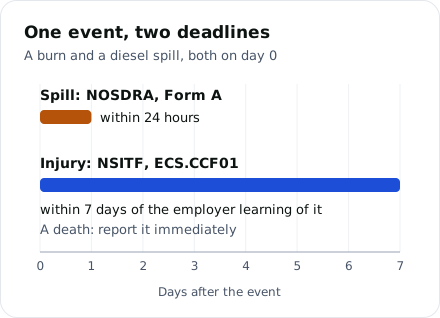
Picture a welder burned by a flash fire that also knocks a diesel drum into a drain. That is one event, but two reports with two deadlines: NOSDRA within 24 hours for the spill, and NSITF within 7 days for the injury. If the injury turns out to be fatal, the NSITF report is due at once.
Knowing the rules is rarely the problem. The problem is that the clock starts on site, while the paperwork starts in the office. A report written on paper and carried back at the end of a shift can lose a day before anyone opens the form.
Where Validuty fits
- Report from the phone, even with no signal. The report is saved on the phone and sent when it reconnects.
- One report, every consequence. An injury, a spill, a fire, damage or a near miss go on the same record, and each one that a regulator cares about starts its own deadline.
- Warnings before the deadline. The people responsible are warned as a deadline approaches, and the report is escalated if it passes.
- The regulator’s own forms. NOSDRA Form A and NSITF ECS.CCF01 are filled in from the record, on the official forms, for you to check and submit. Your team can set up other forms in the report template editor.
- A record nobody can quietly change. Every step is on a tamper-evident audit trail, ready when the regulator asks.
This article is a summary to help you plan, not legal advice. Check the current Acts and forms with the regulator or your legal adviser.
Sources: NOSDRA Form A · NSITF ECS.CCF01 · Employee’s Compensation Act 2010 · NUPRC Form 41 · Upstream Petroleum Safety Regulations 2024
Want to see how a report reaches the regulator on time? Book a demo with us.